Why our team’s induction starts with a psychology book, not a property manual
Every letting agency trains its team on the same things. The Housing Act. Tenancy law. Maintenance workflows. Property software. We do all of that too; it's the baseline.
The difference is what we train alongside it.
Early in every new starter's induction at Nola Living, four books land on their desk: The Chimp Paradox. Emotional Intelligence. Nonviolent Communication. Difficult Conversations. Psychology, taught from day one, not bolted on as "soft skills" six months later when there's time.
Most agents stop at the systems. We don't.
This sometimes surprises people. A letting agent, training its team in psychology?
It's the single biggest reason our houses run the way they do.
Most property complaints aren’t about property
After years of managing HMOs, we figured something out.
The phone calls we got weren’t really about what they said they were about.
The “noise complaint” was usually a tenant who’d had a bad week and now resented her flatmate watching TV on Tuesday nights.
The “cleanliness issue” was usually two housemates with different definitions of clean and a passive-aggressive WhatsApp thread that had been simmering for three weeks.
The “maintenance request” was sometimes a tenant who felt unheard about something much bigger, and was finally finding something concrete to attach it to.
Most managing agents respond to the surface of the complaint. They send the contractor. They write the warning letter. They log the issue.
We trained ourselves to respond to what’s underneath.
That’s what the books are for.
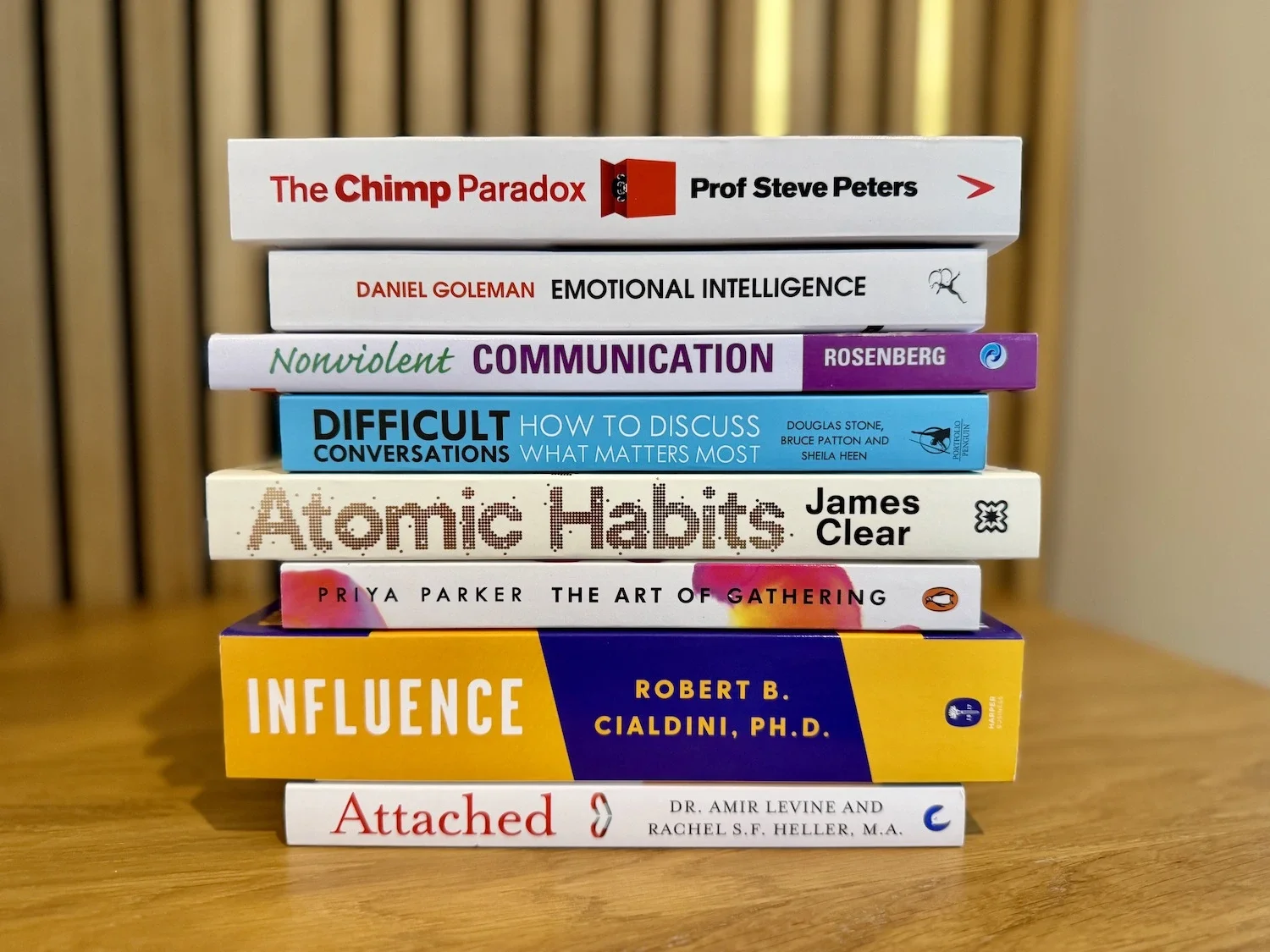
The first four books behind our team
The Chimp Paradox teaches our team to recognise when someone is reacting from the emotional brain rather than the rational one and how to respond without inflaming it. When a tenant calls, furious about something small, the chimp is in charge. Meeting them with calm, structured authority de-escalates faster than any policy ever could.
Emotional Intelligence underpins how we listen. Empathy without absorption. Hearing tenants out without becoming their therapist. Holding standards without becoming the bad guy.
Nonviolent Communication informs how we write. Most conflict in property management escalates because of how things are said, not what is said. Our internal templates, for noise complaints, behaviour breaches, late rent reminders, are built on this framework. Same boundaries. Worded in a way that doesn’t trigger defensiveness in the person reading them.
Difficult Conversations is the one we lean on hardest. Because property management is difficult conversations. Cleanliness. Noise. Smoking. Parking. The agents who avoid those conversations end up with houses that quietly fall apart. The agents who charge at them end up with houses tenants leave. The third option, calm, firm, clear, is the one this book teaches.
The next tier of books
The reading list doesn’t stop there.
Atomic Habits shapes how we design shared spaces. Bins in obvious places get used. Rotas at eye level get followed. Friction matters more than reminders.
The Art of Gathering reframes our onboarding process. When a new tenant moves in, we treat it as the beginning of a community, not the end of an admin task. The first conversation sets the tone for the next eighteen months.
Influence informs how we ask for things. Compliance comes from trust and norms, not threats. The way we communicate house rules has more to do with social proof than enforcement.
Attached changes how we hold boundaries with tenants. Some become over-dependent on their property manager, calling constantly, expecting more than the service is for. Others disengage entirely, ignoring messages until something breaks. Both patterns are predictable once you understand attachment styles, and the book trains our team to support either type without over-functioning, and without becoming cold.
These books don’t sit on a shelf. They sit in every conversation our team has with a tenant, every internal note about a property, every decision about who moves in where.
What it means if you’re a landlord
The result is something most agents struggle to deliver: calm houses.
Fewer escalations. Longer tenancies. Tenants who feel heard and managed at the same time. A property manager who picks up the phone and doesn’t make the situation worse.
We’re not pretending psychology solves everything. There are days when the kettle leaks, the boiler dies, and the third tenant in a row decides to leave. But the texture of those days, how they land for you, as a landlord, is shaped by who’s on the other end of the phone, and how they’ve been trained to think.
We’ve decided who’s on our end of the phone. And we’ve decided how they think.
Most letting agents will tell you they’re “people people.” We’ve gone further than that. We’ve made it operational.
Psychology isn’t a soft skill at Nola Living. It is the training programme.
That’s the bookshelf behind every house we run. It’s also one of the bigger reasons we don’t think of ourselves as a letting agent any more. We’re something more specific. A management approach built on human dynamics rather than admin workflows.
You can manage a property in a lot of ways. We’ve chosen the one that works.
Oli & the team
Nola Living · HMO management specialists